


UR-100V LightSpeed: Time, Space, and Light on Your Wrist!

An odyssey through the cosmos at the speed of light
In an era where science fiction blends with reality, certain numerical values embody reassuring, universal, even eternal characteristics. Among them is the number 299,792.458 km/s. It is a number steeped in mystery, rooted in the theory of classical mechanics while evoking the imagination of authors such as Isaac Asimov. It represents the ultimate speed, the propagation of energy—a concept mastered only by those in the know. This universal constant, the speed of light, symbolized by the letter “c,” transcends the boundaries of time and space.
This almost mystical number evokes both Einstein’s principles of relativity and the futuristic reveries of distant galaxies explored by the Jedi of “Star Wars” and the intrepid captains of “Star Trek.” To master this speed is to plunge into hyperspace, defy the laws of physics, and navigate through the multiple dimensions of the universe. An adventure worthy of the greatest explorers, from the Goa’uld tacticians of “Stargate” to the Navigators of the Spacing Guild in “Dune.”
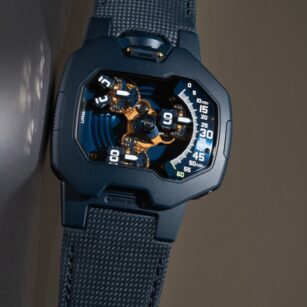
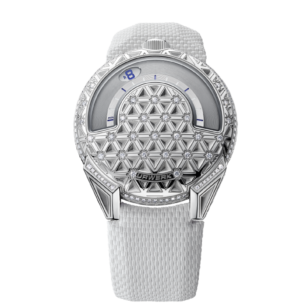
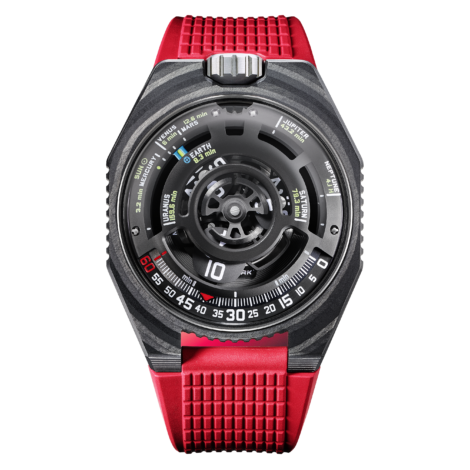
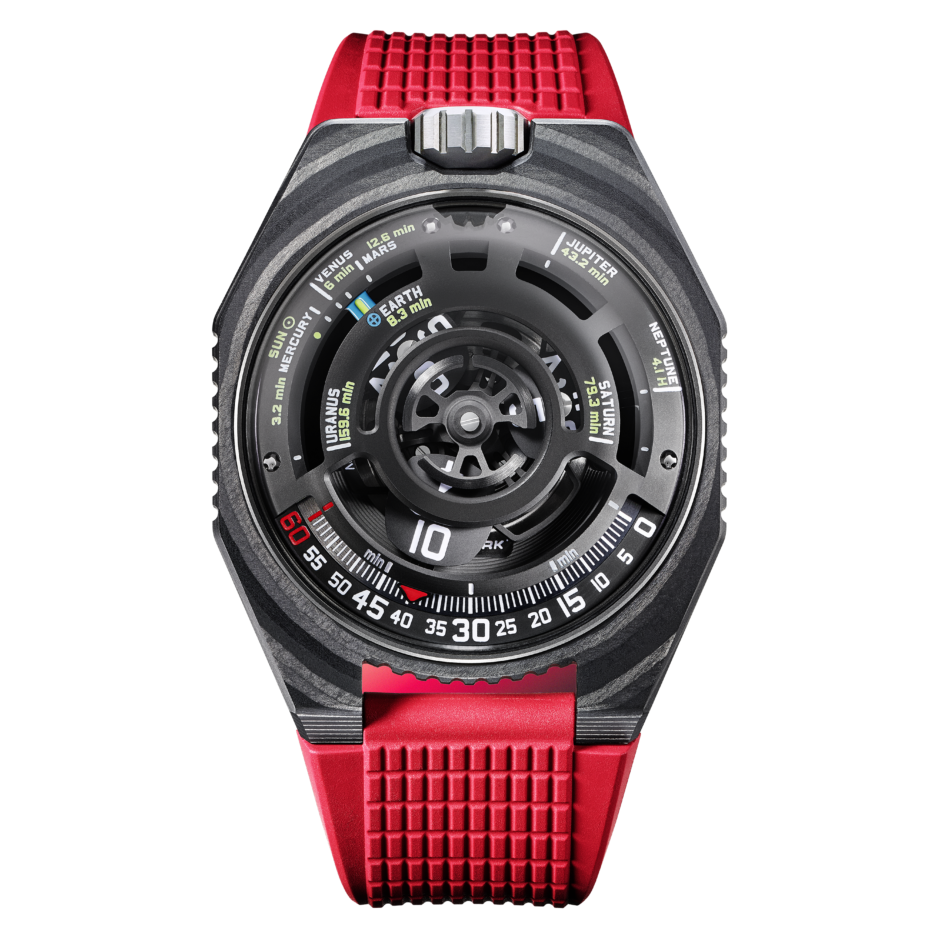
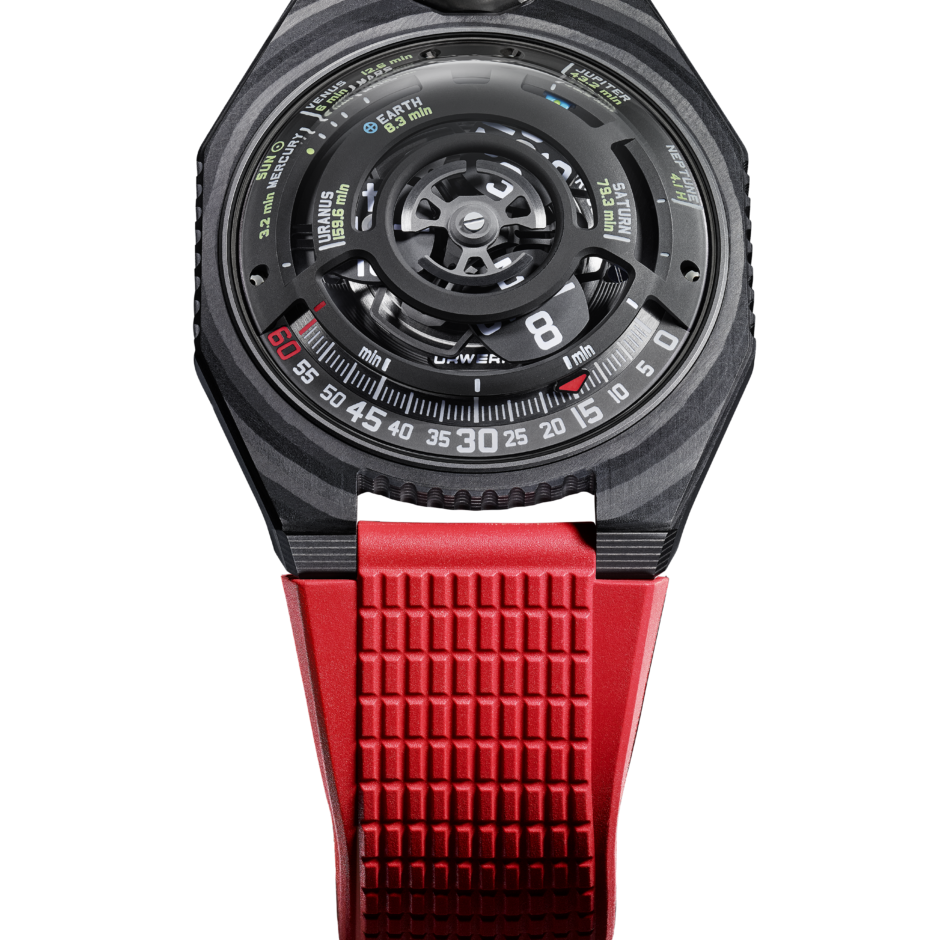
URWERK’s UR-100V LightSpeed embodies this dream by uniting Time, Space, and Light into a single unit. Martin Frei, artistic director and co-founder of URWERK, tells us: “Wearing this creation is like having a fragment of the universe on your wrist, a miniature vision of the cosmos on a human scale.” The UR-100V LightSpeed houses a three-dimensional planetarium featuring eight celestial bodies from our solar system—eight reference points. Martin explains: “Starting from the Sun, we calculated and represented the time it takes for a ray of light to reach each of the planets. Thus, a ray of sunlight will take 8.3 minutes to reach Earth, while that same ray will reach Jupiter’s surface 35 minutes later. It’s a journey through space and time aboard the most magical vessel there is: light.” Felix Baumgartner, master watchmaker and co-founder of URWERK, adds: “This is the story we’ve been told since childhood—the one that explains our place on Earth, the immensity of the universe, and our time-shifted relationship with the present. By the time a star’s light reaches us, that star has long since ceased to shine. We perceive a time long past.”
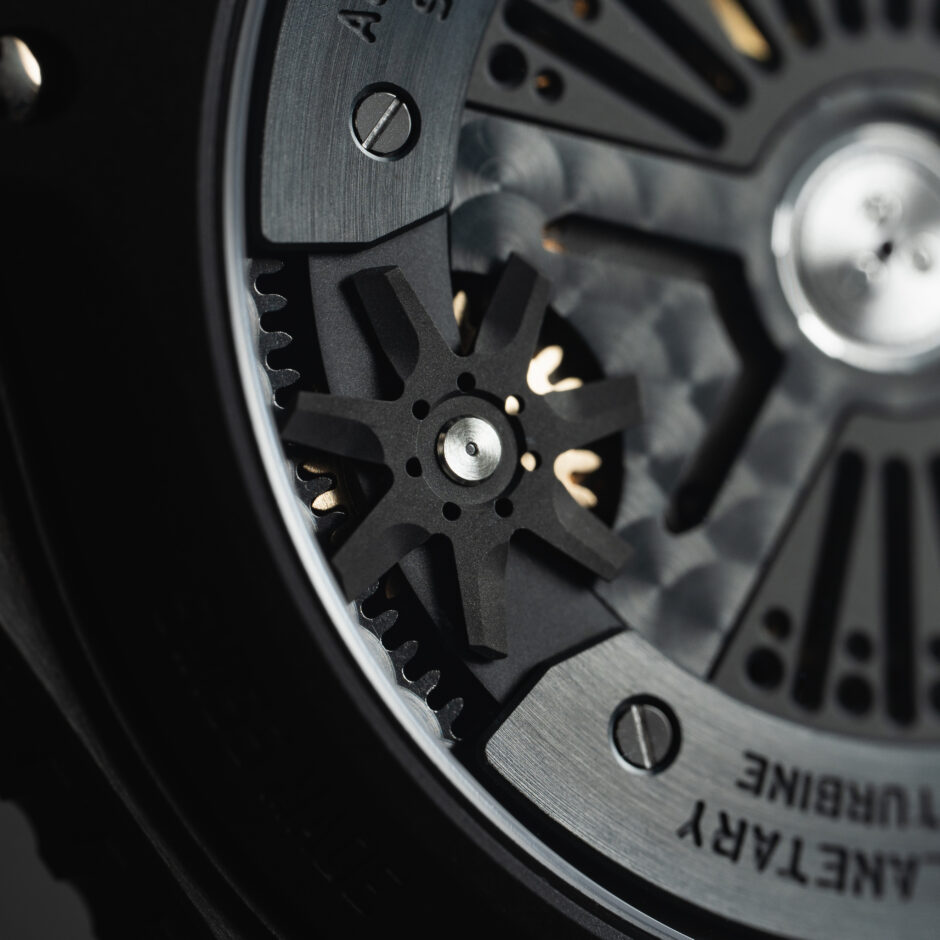
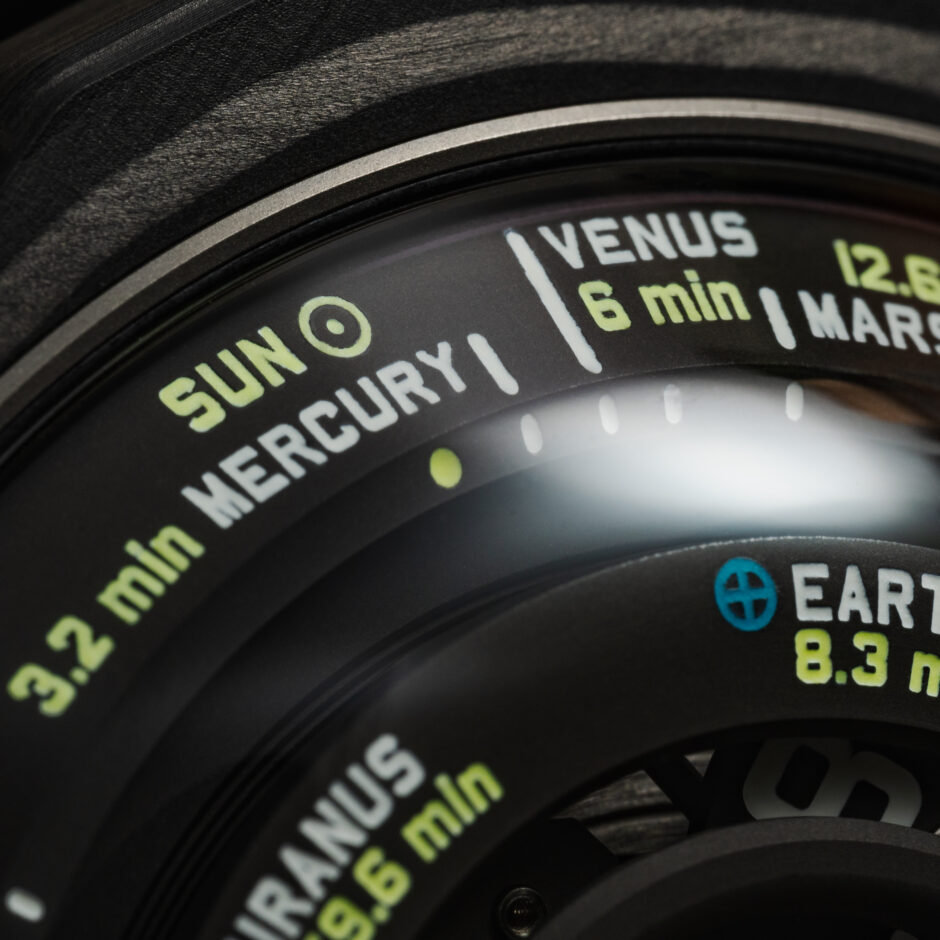
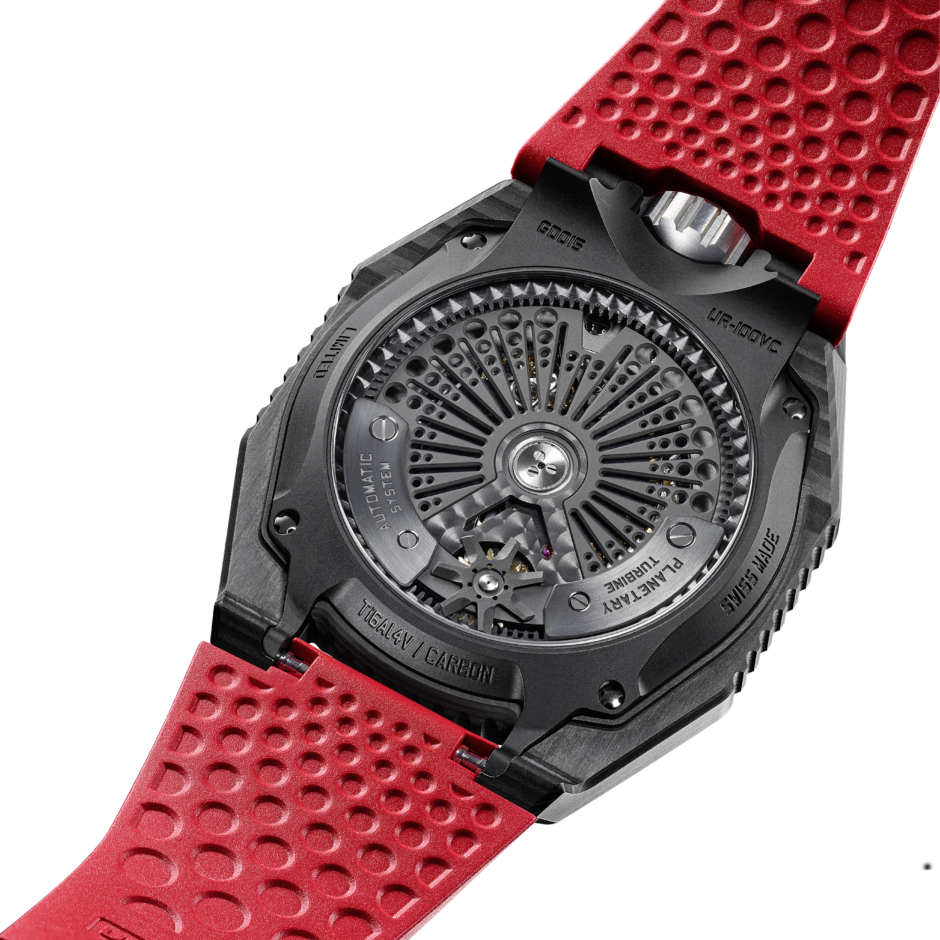
Indeed, a ray of sunlight reaches each planet in our system in a specific amount of time, reminding us of the staggering distance and the fleeting beauty of our universe. The light we perceive today is an echo of the past, a moment frozen in cosmic time. In our spacetime system, the Sun’s rays reach Mercury in 3.2 minutes, Venus in 6 minutes, Earth in 8.3 minutes, Mars in 12.6 minutes, Jupiter in 43.2 minutes, Saturn in 79.3 minutes, Uranus in 159.6 minutes, and Neptune in 4.1 hours. All this beauty is embodied by the UR-100V LightSpeed, whose rotor—inspired by the Sun—is located at the back of the timepiece. Martin Frei concludes: “Light establishes a fundamental link between us and the Universe. It is the smallest unit of transmissible energy, and our eyes are remarkably well-adapted to capture its specific electromagnetic radiation. This ability to perceive and interpret light redefines our perception of the world. Whether we are gazing at distant stars or scrutinizing the world through a microscope, light provides us with essential information, influencing our understanding of reality and constantly expanding our knowledge of the vast and complex universe.”
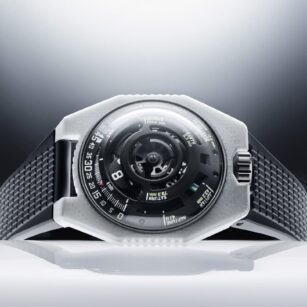
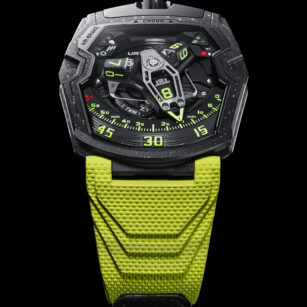
In addition to its interstellar dimension, the UR-100V LightSpeed reinvents the display of hours and minutes by doing away with traditional hands. In their place, a satellite moves along a graduated arc. The first satellite indicates the hours, while the second indicates the minutes. When a hour satellite has completed its 60-minute cycle, the next one—bearing the following hour—appears in front of the 0-minute marker. This innovation, inspired by a 17th-century clock, is a dazzling display of creativity that pushes the boundaries of space, volume, and time.
UR-100V “LightSpeed”
Movement
Caliber UR 12.02 with an automatic winding system driven by a streamlined propeller,
the Windfänger
40 jewels
Frequency 28,800 v/h – 4 Hz
Power reserve 48 hours
Materials: Satellite hour discs in aluminum set on Geneva crosses in beryllium bronze
; aluminum carousel; triple ARCAP plate; water-resistant internal
titanium case; black PVD-coated aluminum rotor.
Finishes: Circular graining, sandblasting, microbeading, circular brushing
Chamfered screw heads
Hour and minute indices painted with SuperLumiNova
Displays: Satellite hour; minutes; the time it takes for a sunbeam to reach 8 of the
planets in the solar system.
Case Material: Black carbon (54-layer ThinPly). Case back: Sandblasted, microbead-finished Grade 5 titanium
with black DLC coating.
Dimensions Width: 43 mm; length: 51.73 mm; thickness: 14.55 mm
Glass Sapphire crystal
Water resistance Screw-down crown. Water-resistant case. Tested to 5 ATM (50 m)
Hour and minute markers painted with SuperLumiNova
Displays: Satellite hour; minutes; the time it takes for a sunbeam to reach 8 of the
planets in the solar system.
Textured rubber bracelet with a folding clasp